
By: Jeremy Sikkema
There’s a stat I focus on just as much as swim pace, watts, or finish time: smiles per hour. It’s not on any results page, but it’s the number that actually tells you whether a race day was a good one. I’ve now done the South Haven Triathlon twice, and the two races couldn’t have looked more different — yet somehow both scored high on the metric that really counts.
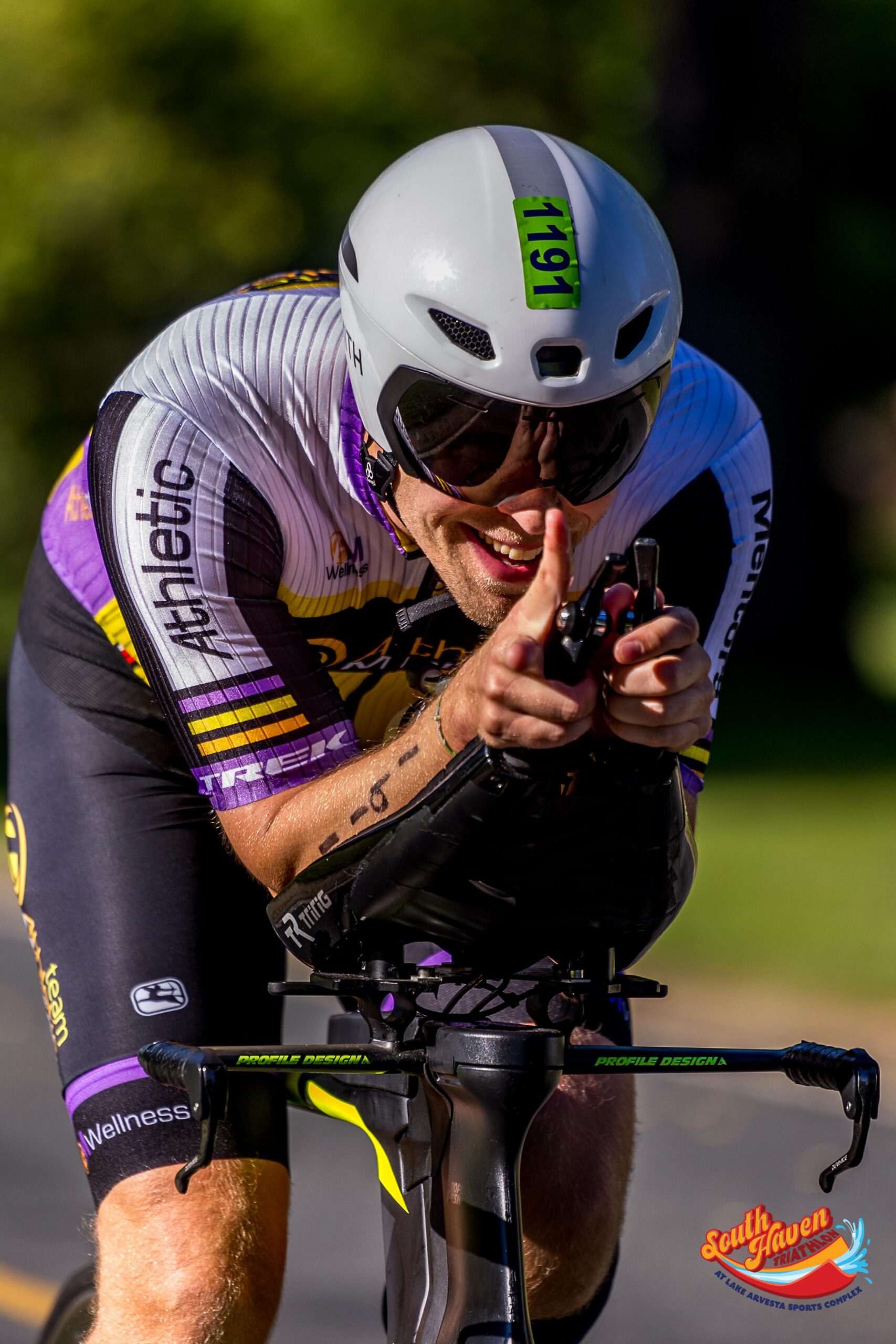 South Haven has become one of my favorite races on the calendar, and 2025 and 2026 gave me about as different a pair of experiences as you can have at the same event. One year I had the fitness and thought I had the race. The next year I had neither — and ended up with the win. Here’s how it went both times, and what it taught me about chasing smiles instead of just chasing splits.
If you haven’t done this race, here’s the short version: it’s a sprint triathlon at Lake Arvesta Farms Sports Complex in South Haven, Michigan, and it opens with a 240-foot water slide instead of a traditional swim start. You read that right. I was lucky enough to be there for the inaugural year in 2025, and came back to defend — or in this case, avenge — in 2026. Full details, courses, and the slide itself (yes, it’s real) are on the race website: www.southhaventri.com. Both years I raced it, the swim leg used a time trial start — athletes go down the slides three at a time, sent off in waves every 15 seconds — so in both 2025 and 2026, I had no idea where I stood in the field until results posted.
2025: Footprints in the Dirt
Coming into South Haven in 2025, I was in good shape. Training had been consistent, the numbers on TrainingPeaks looked sharp, and I lined up expecting to either win the race outright or be right there in the mix. With the time trial slide start, there was no pack to gauge myself against — just my own effort and a watch — but I went off in one of the earlier groups and figured I’d be racing toward the front of the field most of the day.
The swim and bike went about as planned. I came off the bike feeling strong and, for a while, believed I was leading the race. That’s a great feeling — until it isn’t. Running down the winding path, I started noticing footprints in the dirt ahead of me. Fresh ones. Someone else’s.
I hadn’t seen this guy at all — he wasn’t someone I’d raced before — and he’d clearly come out of T2 just far enough ahead that he was never in my sightline. No glimpse on an out-and-back, just a gap and a trail of prints in the dirt telling me the truth before my eyes could confirm it. I pushed, but the gap was there, and I crossed the line in second.
Was I disappointed? A little, in the moment. I’d come in with good fitness and high expectations. I left smiling anyway — just not as wide as I’d hoped.
2026: Carrots, the Back of the Pack, and an Empty Tank
A year later, by the time South Haven rolled back around in 2026, my training block looked nothing like 2025’s. I’d logged more boarding passes than swim, bike, or run sessions over the previous two weeks — work travel had taken over my calendar, and my TrainingPeaks fitness chart was telling a pretty honest, pretty unimpressive story.
Here’s the thing about a two-week dip in training, though: it’s a lot less catastrophic than it feels. As TrainingPeaks lays out in their breakdown of detraining](www.trainingpeaks.com/blog/how-much-down-time-is-too-much-the-concept-of-detr/), the real, measurable losses in aerobic and threshold fitness build gradually and don’t meaningfully erase your fitness until you’re well past the two-week mark — a short stretch of missed sessions dents your confidence a lot more than it dents your actual engine. I knew that going in, but staring at a flat TrainingPeaks chart the morning of a race still has a way of getting in your head.
This time, though, I started toward the back of the slide-start groups instead of the front — about 20 minutes behind the first wave off the slides. Starting deep in the field meant I’d be passing people most of the morning. With fitness I was questioning, I decided to treat every swimmer, rider, and runner I caught as a carrot. Reel them in, use them to keep pushing, and worry about the overall results later.
That’s exactly how the day unfolded. I worked through the field one carrot at a time, never knowing my actual position, just knowing I had more to give. By the run, I’d committed to emptying the tank completely. I crossed the line having left everything out there, and when the results finally posted, I’d won the race by four seconds.
Four seconds. After two weeks of plane rides instead of pool laps. After starting toward the back of the slide groups with zero feedback on where I actually stood until the results were checked. It’s the kind of finish that reminds you that consistency of years and months matter more than missing a couple of weeks.
The Takeaway
Put these two races side by side and the lesson isn’t about fitness levels or what TrainingPeaks says on a given race day. In 2025, I had the legs and lost the race. In 2026 I had doubt, a flat training log, and a start format that kept me guessing, and I won by four seconds because I raced every minute like someone was right on my shoulder.
Smiles per hour isn’t about being happy-go-lucky out there. It’s about staying present, racing as hard as you can, and being grateful that you are on the race course. Trusting that the work you’ve done — even an imperfect, travel-interrupted version of it — is usually still there when you need it. South Haven gave me a runner-up finish and a win in back-to-back years, and both versions had their share of smiles.
 Athletic Mentors