
Reduce Aero Drag and Rolling Resistance using the Chung Method – Part #3

Athletic Mentors » Reduce Aero Drag and Rolling Resistance using the Chung Method – Part #3

Reduce Aero Drag and Rolling Resistance using the Chung Method – Part #3

November 11th, 2025 by JoAnn Cranson

By: Jay Campbell

Blog 3 Drag Reduction Studies using the Chung Method 

We are all in search of ‘free speed’: cycling faster at our current fitness level. For time trialists it is all about reducing aerodynamic drag. For gravel racers, reducing rolling  resistance predominates. But how do you know if an equipment change or body-position  change is faster for YOU? 

This is a blog in three Parts: 1) The Chung Method, 2) Rolling Resistance on Gravel, and 3)  Aerodynamic Drag on Pavement. You can skip to the topic of interest, but the blogs build on  each other. 

This is Part 3 of three blogs on the reduction of drag and rolling resistance using the Chung  Method. Part 1 briefly explained the Chung method and why I have confidence in its results. Part 2 provided an example of using the Chung Method to test rolling resistance on gravel. This blog will show the application of the Chung Method to determine the optimal  aerodynamic hydration system for my set-up.

I recently published a blog showing watts/CdA to be the quantity to  be optimized for flat time-trialing. CdA is the coefficient of drag and is a function of rider  position and bike characteristics. The blog provided a graphical method to find your CdA  using time-trial data. 

CdA is notoriously hard to measure. Expensive wind tunnel testing has long been the only  reliable method of accurately measuring CdA. The advent of power meters gave more  possibilities for amateur measurement of CdA. I wrote about one of those, AeroTune, in a prior blog. More recently I have used the Chung  Method to measure rolling resistance on my gravel bike (See Part 2). The Chung method not only appears to be very sensitive to changes in CdA, but its visual representation of test data provides a good double-check on the accuracy of the data. 

Example: Determine how different hydration systems affect CdA. 

I tested four different “hydration system” setups on my triathlon bike to determine which  had the lowest CdA. They are described and shown below.
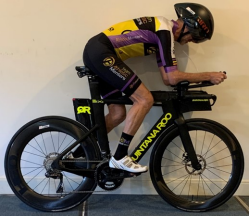
1) BASELINE This is my normal set-up. The hydration system is the integral front water bottle in the Quintana Roo PR series.

2) TORPEDO Addition of the XLabs Torpedo Versa 200 LINK  to the Baseline setup.
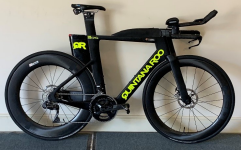
 

4) NO QROO BOTTLE This is the bike with no hydration system.
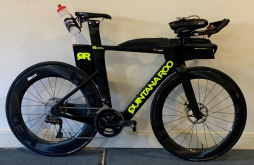
3) TORPEDO + DELTA Addition of the XLabs Delta 430 LINK  to the Torpedo setup.


Testing Protocol: 

Each test is 8 laps running back and forth on a 1/8th mile section of paved road. This  section of road has a dip with about 15 feet of elevation on each side. The grade is steep  enough that no brakes were used to make the U-turn. Shifting was minimized, using a high  gear throughout the test. I used aero bars except for U-turns. Max speed was about 23 mph  at the bottom of the dips and an average speed of 15 mph. Average watts was about 90  (one of the advantages of this method is that you do not need to wear yourself out to get  good data.) The conditions were calm with winds at 3-4 mph (the back and forth nature of  the test is designed to remove wind effects.) I used a calibrated Garmin Speed Sensor and  double-sided Garmin Power Pedals. Each test was saved as a Garmin workout. All seven  workouts were exported from Garmin Connect as TCX files and imported into Golden  Cheetah [freeware available at this LINK . The seven  workouts were combined and analyzed in the AeroLab Chart using the Chung Method (See  Part 1). 

Data Analysis 

The chart below shows the entire test session as one continuous workout. I find this very  appealing as I can visually gain some confidence that my data are accurate. If I have  estimated the BASELINE CdA correctly, the BASELINE plot should just be an elevation  profile of my ride. Because I am riding back and forth across a dip, the lower elevation  should be the same for each lap, but the upper elevation should vary as the two sides of  the dip are not at the same elevation. This is more visible in the second test. REMEMBER,  this elevation data is not from GPS! This is from the Power Balance Equation that says IF I  AM PUTTING IN THIS MUCH POWER AND SLOWING DOWN, I MUST BE GOING UPHILL (in  simple terms.)
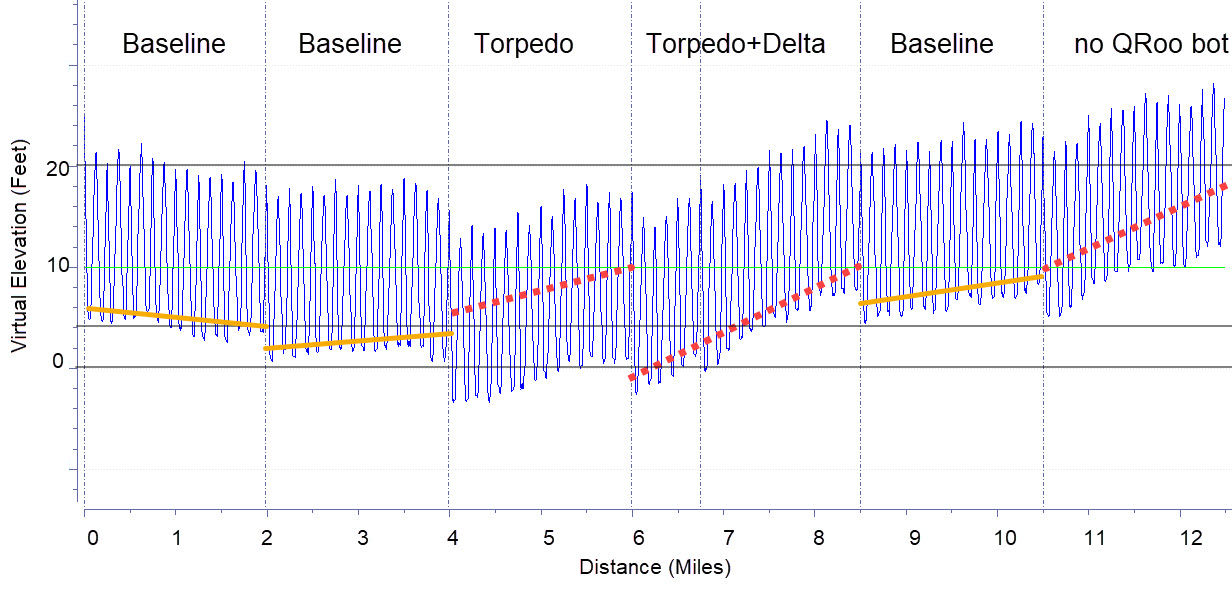
If the test is reproducible, all of the 3 BASELINE tests should be the same. The orange lines  show the apparent slope trends of the BASELINE tests. The variation in the baseline slopes  corresponds to about +/- 1 watt. Any conclusions are therefore subject to a +/- 1 watt error.  That reproducibility is improved if the first test is discarded. That could be argued as  legitimate, as I was just getting comfortable with the course and using many gear changes  during that first test. 

The red-dotted-line slopes are drawn for the 3 tests different from BASELINE. They are  different and consistent enough to be considered significant. The data are saying that for  that equipment configuration, additional power above baseline is required. That additional  power is equivalent to the power needed to climb the slope of the red-dotted-line. In the  case of the TORPEDO that converts to about 2 watts, for the TORPEDO + DELTA about 4  watts, and for the elimination of the QROO BOTTLE about 4 watts. All these results are +/- 1  watt accuracy. 

Note that the TORPEDO+DELTA data was collected over 2 tests (3 laps, then 7 laps) as I had  traffic interference. Despite that, the slopes of the two tests appear very similar, giving  additional confidence in the reproducibility of the data. 

Conclusions: 

The Chung method of measuring changes in CdA is quite rugged and time efficient. The  session above lasted 90 minutes including equipment changes. Each test took 8 minutes  and was at an effort-level that was not exhausting. 

The results confirm that aerodynamics are very dependent on the individual and on the  specific bike design. For example, it cannot be generalized that a behind-the-seat water bottle reduces CdA for everyone. In my case, it appears that the Q Box behind my seat may  be already doing some of the turbulence reduction that the bottle cage does for others. 

The Chung method is simple and accurate enough that anyone with a speed sensor and  power meter should be able to measure changes in CdA for different rider/bike  configurations.



Reduce Aero Drag and Rolling Resistance using the Chung Method – Part #1

November 5th, 2025 by JoAnn Cranson

By:  Jay Campbell

We are all in search of ‘free speed’: cycling faster at our current fitness level. For time trialists it is all about reducing aerodynamic drag. For gravel racers, reducing rolling  resistance predominates. But how do you know if an equipment change or body-position  change is faster for YOU? 

This is a blog in three Parts: 1) The Chung Method, 2) Rolling Resistance on Gravel, and 3)  Aerodynamic Drag on Pavement. You can skip to the topic of interest, but the blogs build on  each other. 

EXAMPLE: Which of four hydration set-ups is most aerodynamic for me? 

The results of 6 x 8-minute tests are strung together and can graphically answer this  question (see below). No wind-tunnel required, only a power meter and a speed sensor.


Blog 1 The Chung Method 

This is Part 1 of three blogs on the reduction of drag and rolling resistance using the Chung  Method. Part 1 briefly explains the Chung method and why I have confidence in its results.

The method was developed by Robert Chung, Professor at UC-Berkeley, a decent cyclist  himself. The mathematical method is elegantly simple. It solves the Power Balance  equation for SLOPE (s), using guesses for CdA and Crr (drag and rolling resistance).  

The Math 

The Power Balance says that the cyclist’s power is consumed by 4 components: 1) rolling  resistance 2) changes in elevation 3) acceleration and 4) aerodynamic drag. It can be  written mathematically as: 

Power meter (watts) = Crr m g v + s m g v + m a v + ½ CdA ρ v³ 

v = speed (m/s) 

m = mass of bike+cyclist (kg) 

g = gravitation constant (9.81 m/sec²

Crr = coefficient of rolling resistance  

s = slope  

a = acceleration  

ρ = air density  

CdA = aerodynamic drag area 

Slope multiplied by velocity gives the change in elevation which are strung together and  plotted. This elevation is referred to as “Virtual Elevation” as all of the unaccounted for  “power” in the Power Balance, whether it is related to elevation gain or not, is converted to  elevation. Chung gives a detailed description of his method here.

Testing Protocol 

There are several ways to collect the data to answer drag and rolling resistance questions,  but my experience has led me to the following protocol. 

Equipment: Power meter (if pedals, two-sided is preferred), Speed Sensor (if you are testing  tire pressures, calibrate sensor for each pressure), and a cycle-computer that will capture  the power/speed data and export it as a tcx file. 

Course: My preferred course is a dip in a quiet road that is about .2 miles across. The sides  of the dip must be steep enough to slow you to a U-turn without braking.  The Test: Start your cycle-computer from one side of the dip and do 5-7 back-and-forths,  about 8-10 minutes. On the last length come to almost a complete stop without braking  and stop your cycle-computer. 

Test Order: I always start my testing with my preferred set-up which I call BASELINE. It has  also become my practice to repeat the BASELINE as my second test. This gives me insight  into the reproducibility of the results. The next two tests are modifications to my baseline  set-up. My fifth test is another repeat of BASELINE.

Analysis 

The tests are uploaded as tcx files into the freeware, Golden CheetahI like to paste all of the tests together so I can look at the  entire session on one plot. Golden Cheetah performs the calculations to create a plot of Virtual Elevation versus Distance. The guesses of Crr and CdA can be adjusted until the  elevation of the start and end of the Baseline tests are equal (zero slope). If the slope of a  test is positive, more power is required for those test conditions (it is like ascending a  virtual hill.) Conversely, if the slope of a test is negative, less power is required for those  test conditions (it is like descending a virtual hill.)                      Example: 

Why I like the Chung Method 

  1. The Chung Method is Visual I have a lot more confidence in the result when I can  see that there is a trend in the data and that the trend is consistent. I have used  other methods where the test result is a number (for example CdA is x.xx). If I want a  second confirmatory number, I need to do another test. To get the number of data  points you see above would take a long long time. In the example above, each valley  is the bottom of the dip. In this case I did 8 loops, so I have 16 data points for the  elevation of the valley in each test. If that elevation was jumping all over the place, I  would place little confidence in the results. The slopes of the 3 BASELINE tests do  vary, which gives me an idea of the error involved in making any conclusions. I can also visually see that there are significant trends in the 3 non-BASELINE tests. I have  estimated their slopes with red dotted lines.
  2. The Chung Method is robust I have performed a test where I just rode in circles in a  parking lot in windy conditions with a single-sided power meter. The results were a  bit ‘noisy’, but definite trends could be seen in the analysis. 
  3. The Chung Method is not exhausting Some drag protocols require cycling for two kilometers at a high effort. Cycling the “dip” gets the cyclist to high speeds at the  bottom using little energy.  
  4. The Chung Method session for 4 variables can be done in less than 90 minutes The  above example took about 75 minutes. Each test was 8 minutes. Getting ready for  the next test took about 4 minutes. Considering the quality of the data from these  75 minutes, it was worth the time. 
  5. The Chung Method can detect small changes My results showed that variations as  low as one watt were significant. Chung says that with a bit of experience the variability of CdA measurements can be less than 0.5%

The next blog will discuss an actual example of the Chung method with Rolling Resistance  on Gravel.


  • Contact Us

    Athletic Mentors
    269.743.2277

    8610 North 32nd St - P.O. Box 641 - Richland, MI 49083